Earth science field guide
Tectonic plates and earthquakes: why the dots follow the boundaries
Tectonic plates move slowly, but faults often slip suddenly. Stress builds where rocks resist motion, and an earthquake happens when a fault ruptures and releases some of that stored energy. This explains why earthquake locations often trace plate boundaries.
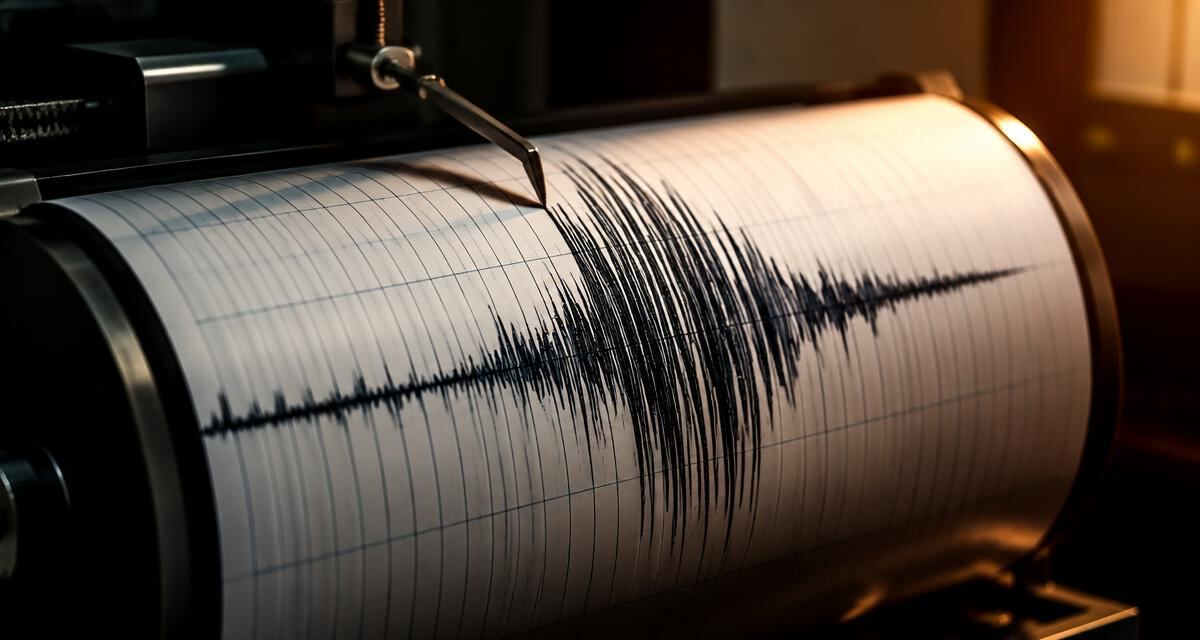
Slow motion, sudden rupture
The lithosphere is Earth’s relatively rigid outer layer. Its plates move over geological time, usually at rates measured in centimetres per year. A fault can remain stuck while nearby rocks bend and accumulate strain. Earthquake rupture is the sudden movement that releases part of that strain as seismic waves.
The point where rupture begins underground is the hypocentre, or focus. The epicentre is the point directly above it at the surface. The dots on a world earthquake map mark epicentres; they do not show the full size of the fault that slipped.
Different boundaries produce different patterns
At convergent subduction boundaries, earthquakes can occur on the plate interface and within the descending slab. This produces shallow events near the trench and deeper events farther beneath the overriding plate. Continental collisions such as the Himalaya spread deformation across thrust faults and broad mountain belts.
At divergent ridges, stretching and faulting accompany the creation of new oceanic crust. Transform boundaries accommodate sideways motion and commonly produce shallow earthquakes. The three colours on our map describe these broad motion categories; real boundaries may include mixed or oblique motion.
Why earthquakes also happen inside plates
Not every earthquake lies on the nearest coloured line. Old faults can be reactivated within a plate, and stress can be transmitted across large regions. Volcanic processes and some human activities can also generate seismic events.
PB2002 simplifies complex boundaries at world scale. An apparent gap between an earthquake dot and a boundary can reflect intraplate faulting, the geometry of a subducting slab, event-location uncertainty or a boundary too detailed for this model. It is not automatically a mapping error.
Magnitude is not the same as local damage
Magnitude describes an earthquake’s overall size. Intensity describes shaking at a particular place. Depth, distance, rupture direction, ground conditions and building construction all affect what people experience. A smaller shallow earthquake near a city can be more damaging there than a larger distant event.
A count of recent earthquakes is not a measure of safety. USGS coverage and magnitude thresholds vary, and preliminary events can be revised. Our day feed includes all reported magnitudes, while the week and month feeds use higher thresholds. Compare time windows and thresholds before comparing counts.
Use a live feed as evidence, not a forecast
The map and statistics share the same received USGS feed. Checks occur every second while the page is visible, but USGS summary feeds are published approximately every minute. Repeated checks may return the same source timestamp; that is normal.
This site does not provide earthquake prediction, early warning or emergency dispatch. Read official event pages for updates and follow local emergency authorities for safety information. A short-lived cluster alone is not evidence that a larger event is imminent.
Map investigation: distinguish an epicentre from a fault
Select a reported earthquake near Japan or western South America. Record the event time, magnitude and depth, then compare its epicentre with the nearest red-orange boundary. The dot is a surface location above the earthquake’s focus; the fault rupture and descending slab are three-dimensional features that a flat world map does not display.
Follow the USGS event link before attributing the event to a specific fault. Record whether the report is preliminary and keep the feed window alongside your notes. A deep earthquake can plot inland of a trench because the slab dips beneath the overriding plate; distance from the coloured line alone cannot establish an intraplate origin.
Common questions
Do all earthquakes occur at plate boundaries?+
No. Most major global earthquake belts follow plate boundaries, but earthquakes also occur on faults within plates.
Why are some earthquakes deep?+
In subduction zones, a descending slab can remain capable of brittle failure far beneath the surface, producing deep earthquakes.
Does more activity today mean a big earthquake is coming?+
A short-term event count does not establish a prediction. This educational map cannot forecast individual earthquakes.