Earth science field guide
Ring of Fire map: earthquakes, volcanoes and plate boundaries
The Ring of Fire is the broad belt of active plate boundaries around the Pacific Ocean. It is not one fault or one tectonic plate. Its trenches, volcanic arcs and earthquake zones connect many different plates, from the coast of Chile to Alaska, Japan and New Zealand.
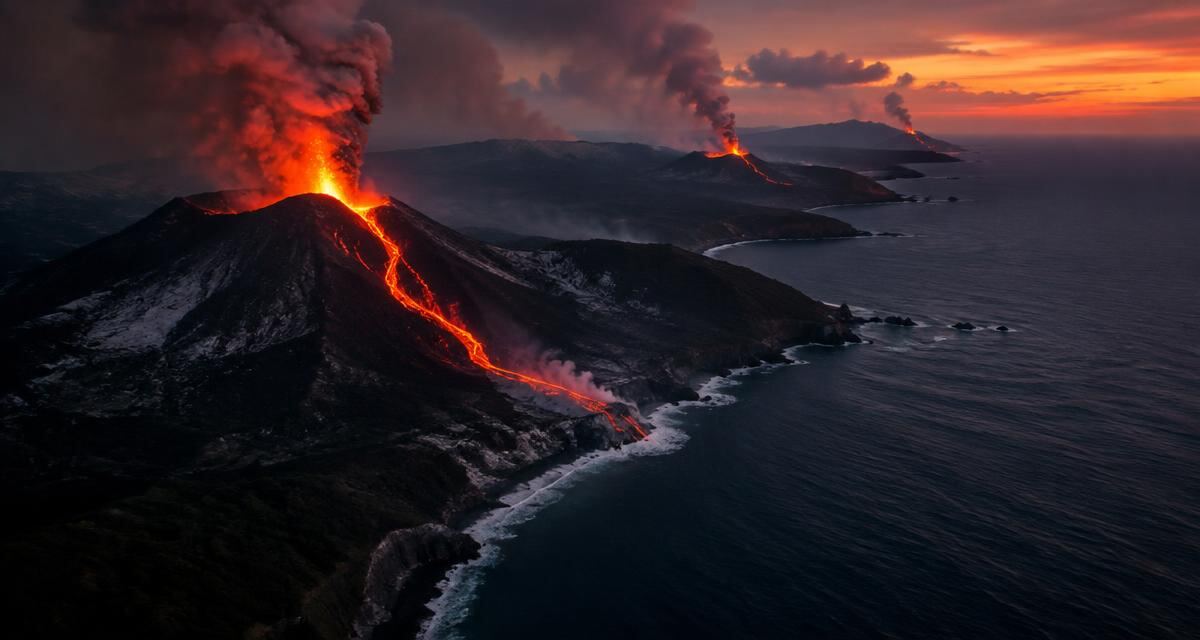
Where is the Ring of Fire?
Follow the western coast of South and Central America north to Mexico, the Pacific Northwest, Alaska and the Aleutian Islands. Across the northern and western Pacific, the belt continues through Kamchatka, Japan, the Philippines and island arcs toward the southwest Pacific and New Zealand.
The name suggests a closed circle, but the geography is closer to a broad horseshoe. The region contains many separate fault systems. A large earthquake in one part does not mean the entire belt has become active as a single connected event.
Why subduction creates volcanoes and large earthquakes
At a subduction boundary, dense oceanic lithosphere sinks beneath another plate. Parts of the plate interface can become locked while the plates continue moving. When the interface slips suddenly, the stored strain is released as an earthquake. Large ruptures of these megathrust interfaces have produced the strongest instrumentally recorded earthquakes.
Water released from the descending slab changes melting conditions in the mantle above it. Some of that mantle melts, and magma can rise to feed a volcanic arc. The trench, earthquake belt and volcanoes are related features, but they occupy different positions across the boundary.
Not every edge is a subduction zone
California’s San Andreas Fault is a transform boundary: the Pacific and North American plates slide past one another. Transform faults generate damaging earthquakes without the continuous volcanic arc typical of a subduction zone. Farther north, the Juan de Fuca Plate subducts beneath North America at Cascadia.
Along western South America, the Nazca Plate subducts beneath the South American Plate. Around Japan, several plates and smaller blocks interact. These regional differences are why a plate-boundary map is more informative than one outline labelled Ring of Fire.
What the live map can and cannot show
Recent USGS earthquakes often outline portions of the Pacific boundary system. A 24-hour sample is only a short snapshot, not a long-term hazard map. A quiet segment may still be capable of a large earthquake; a cluster of small events does not establish a prediction.
Earthquakes outside the Ring of Fire are real and important too. The Himalaya–Mediterranean belt, mid-ocean ridges and faults inside plates can all produce earthquakes. For alerts, tsunami warnings and local safety guidance, use the responsible official agencies rather than an educational world map.
Map investigation: compare Chile with California
Find the Nazca–South American boundary offshore Chile and compare its red-orange line with the yellow transform segments around California. Both regions belong to the wider Pacific earthquake belt, but their relative plate motions differ. The coloured lines explain the distinction that the phrase Ring of Fire alone cannot show.
Inspect an earthquake in each region and record its depth and magnitude from the event information. A day of reports may not provide comparable examples; use a longer feed if needed and state its magnitude threshold. Your observations illustrate boundary settings, not a ranking of future danger or proof that every event occurred on the mapped boundary.
Common questions
Is the Ring of Fire one tectonic plate?+
No. It is a belt of boundaries involving the Pacific Plate and many surrounding plates, including Nazca, Cocos, Juan de Fuca and Philippine Sea.
Is Hawaii part of the Ring of Fire?+
Hawaii’s volcanoes are hotspot volcanoes within the Pacific Plate, not a subduction arc on the plate’s edge.
Can the Ring of Fire map predict earthquakes?+
No. Recent events and plate boundaries show geographic patterns, not the time, location or magnitude of a future earthquake.