Earth science field guide
What causes tectonic plates to move? Slab pull, ridge push and mantle convection
Plates move because Earth is losing internal heat. That heat drives slow flow in the mantle, and the plates themselves are an active part of that system. The strongest single force on many plates is slab pull: the weight of cold, dense lithosphere sinking at subduction zones.
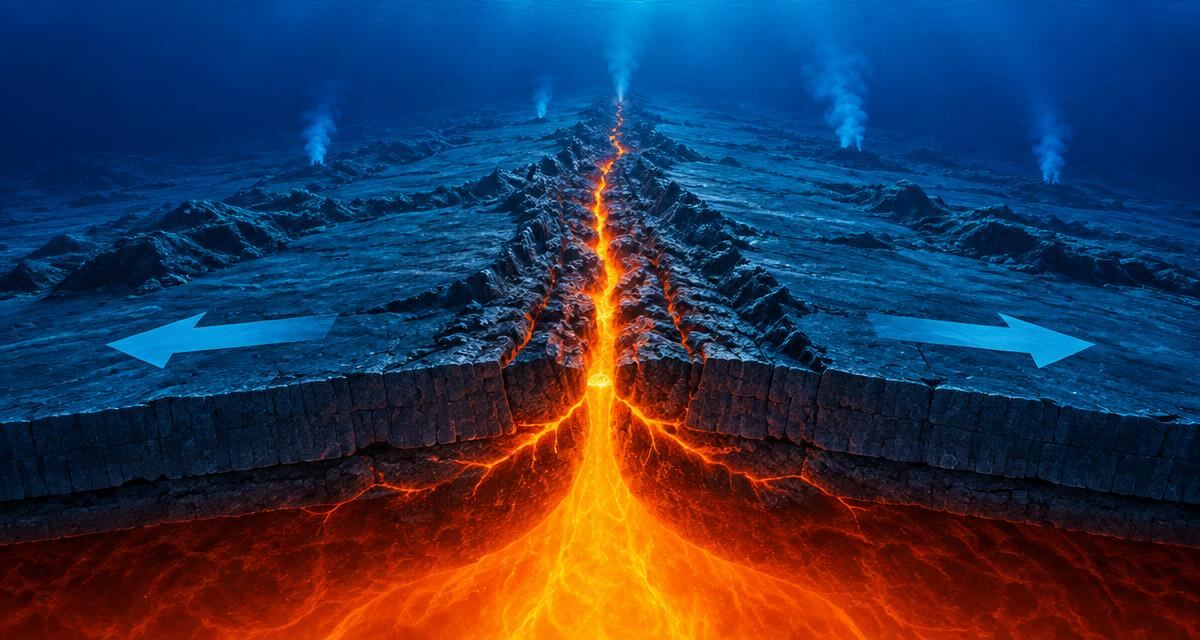
Slab pull
Old oceanic lithosphere becomes colder and denser than the mantle beneath it. Where it sinks at a subduction zone, its weight pulls the rest of the plate along. Plates attached to long subducting slabs, such as the Pacific Plate, tend to move fastest.
Ridge push
At mid-ocean ridges, young hot lithosphere stands high. As it cools and thickens away from the ridge, gravity causes it to slide down and away from the elevated ridge. Ridge push is generally considered smaller than slab pull.
Mantle convection and basal drag
The mantle convects very slowly, heated from below and within by radioactive decay. Plates are the cold upper boundary layer of this convection. Flow beneath plates can help or resist their motion, an effect often described as basal drag. The details remain an active research topic.
How fast plates move
Rates range from below 1 to more than 10 centimetres per year. Some of the fastest spreading occurs on the East Pacific Rise, while the Mid-Atlantic Ridge spreads more slowly. GPS and other space geodesy techniques measure these motions in real time, and they broadly agree with rates inferred from seafloor magnetic anomalies.
Do not picture a conveyor belt under every plate
A simple classroom diagram often draws circular mantle currents dragging plates along the surface. It can introduce heat-driven circulation, but the real system is coupled: sinking lithosphere drives mantle flow as well as responding to it. Plates are the cold outer part of the convection system, not passive rafts above an independent liquid conveyor.
Different forces may help or resist movement along different parts of a plate. The amount of attached sinking slab, the elevated ridge, continental collision and mantle flow all matter. Saying “convection moves the plates” is therefore a useful first answer, but slab pull, gravitational sliding and resistance explain why speeds differ and why one diagram cannot represent every region.
Compare the Pacific with the Atlantic
The Pacific region contains extensive subduction systems as well as fast-spreading ridges. The Atlantic’s familiar central ridge separates plates that also carry large continents. These settings make a useful comparison of plate geometry and force balance, but not a controlled experiment in which one force explains every speed difference.
On the map, trace a plate’s entire perimeter and note where it spreads, subducts or slides past neighbours. A ridge produces new oceanic crust while a descending slab removes older lithosphere from the surface. Both belong to the same global circulation of material and heat. A short earthquake snapshot cannot measure those forces directly.
Turn a speed into a meaningful measurement
“Five centimetres per year” is incomplete unless you know where and relative to what. A GPS station measures the motion of its site in a reference frame; the separation rate across a ridge compares two plates; a hotspot chain can constrain motion relative to mantle volcanism. These measurements need not give identical values.
Magnetic reversal patterns provide spreading rates averaged over geological intervals, whereas satellite geodesy measures present-day motion over years. Fault slip during an earthquake is different again: it is a sudden release of accumulated strain. Do not multiply a rounded annual plate speed by the time since an earthquake and treat the result as a forecast of its next rupture.
Map investigation: find the ridge and the sinking edge
Trace the Nazca Plate between the East Pacific spreading system and the subduction boundary along western South America. Identify where oceanic lithosphere is created and where older lithosphere sinks. This geometry helps connect ridge-related gravitational forces and slab pull, rather than picturing plates as objects carried by a uniform conveyor belt.
The map does not measure forces, mantle flow or speed. For a motion comparison, specify both plates and a reference frame and consult geodetic or geological rate measurements. Two arrows from different reference frames cannot be compared as if they were the same measurement; a live earthquake count is not a plate-speed reading.
Common questions
What is the main driving force of plate tectonics?+
Slab pull is generally regarded as the largest force for plates with subducting edges, operating together with ridge push and mantle flow.
Do plates float on magma?+
No. The asthenosphere beneath plates is mostly solid rock that deforms slowly; magma forms only in limited places.
Can we feel plates moving?+
Not directly. Steady motion is far too slow to feel; we notice it when stored strain is released in earthquakes.